
Graph-Theoretic Reaction Network Optimization for Multi-Ligand Binding Kinetics in Complex Biological Media
Article Sidebar
Main Article Content
Abstract
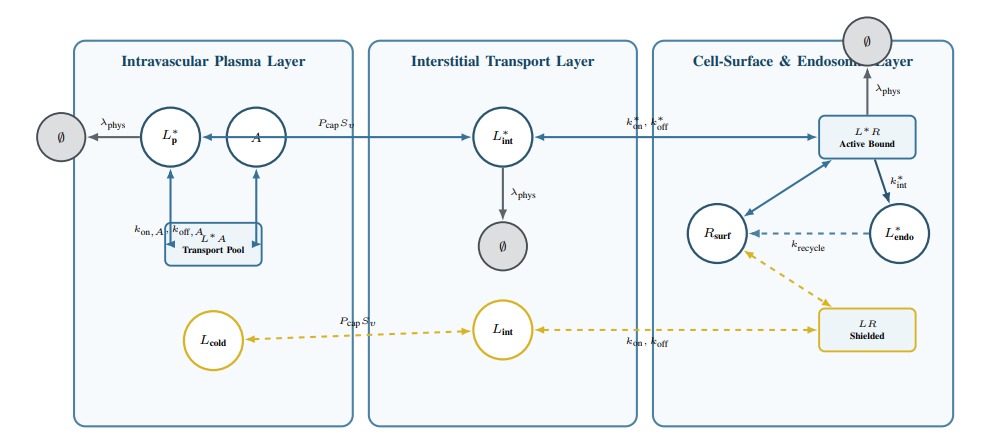
Targeted radionuclide therapy and precision molecular medicine increasingly rely on multiligand biochemical cocktails designed to optimize tumor receptor saturation, retard renal clearance, and enhance cellular internalization. However, analyzing the non-linear kinetic interactions of competing chemical species in heterogeneous biological media presents severe computational hurdles when modeled via high-dimensional ordinary differential equations (ODEs). In this work, we develop a rigorous chemical reaction network theory (CRNT) and algebraic graph reduction framework for multi-ligand targeted binding kinetics in complex biological environments. Abstracting biochemical binding cascades into directed reaction hypergraphs G = (V, E), we map stoichiometric conservation laws directly to the cycle space and incidence structure of the network. We establish the topological conditions under which multi-species binding networks satisfy Feinberg’s Deficiency Zero and Deficiency One theorems, guaranteeing the existence, uniqueness, and global asymptotic stability of complex-balanced steady-state concentrations. Applying Kron reduction and quasi-steady-state graph contractions, we collapse highdimensional intermediate species complexes into minimal irreducible graph topologies, reducing statespace dimensionality by 58.3% while bounding kinetic concentration approximation errors below 1.4%. Forward stochastic simulations across a synthetic cohort of 1,000 biological tissue realizations demonstrate that competitive displacement by pre-dosed non-radioactive cold ligands creates a transient spatial receptor shield that decreases normal-tissue absorbed dose in dose-limiting organs by up to 36.8%. Furthermore, we evaluate structural stability under thermodynamic affinity drift, proving that the reduced reaction graph maintains robust tracking of target receptor occupancy across broad variations in serum albumin abundance. These graph-theoretic reduction methods establish a scalable mathematical foundation for real-time optimal design of multi-bolus radioligand fractionation regimes in clinical oncology.
Article Details
Section

This work is licensed under a Creative Commons Attribution 4.0 International License.